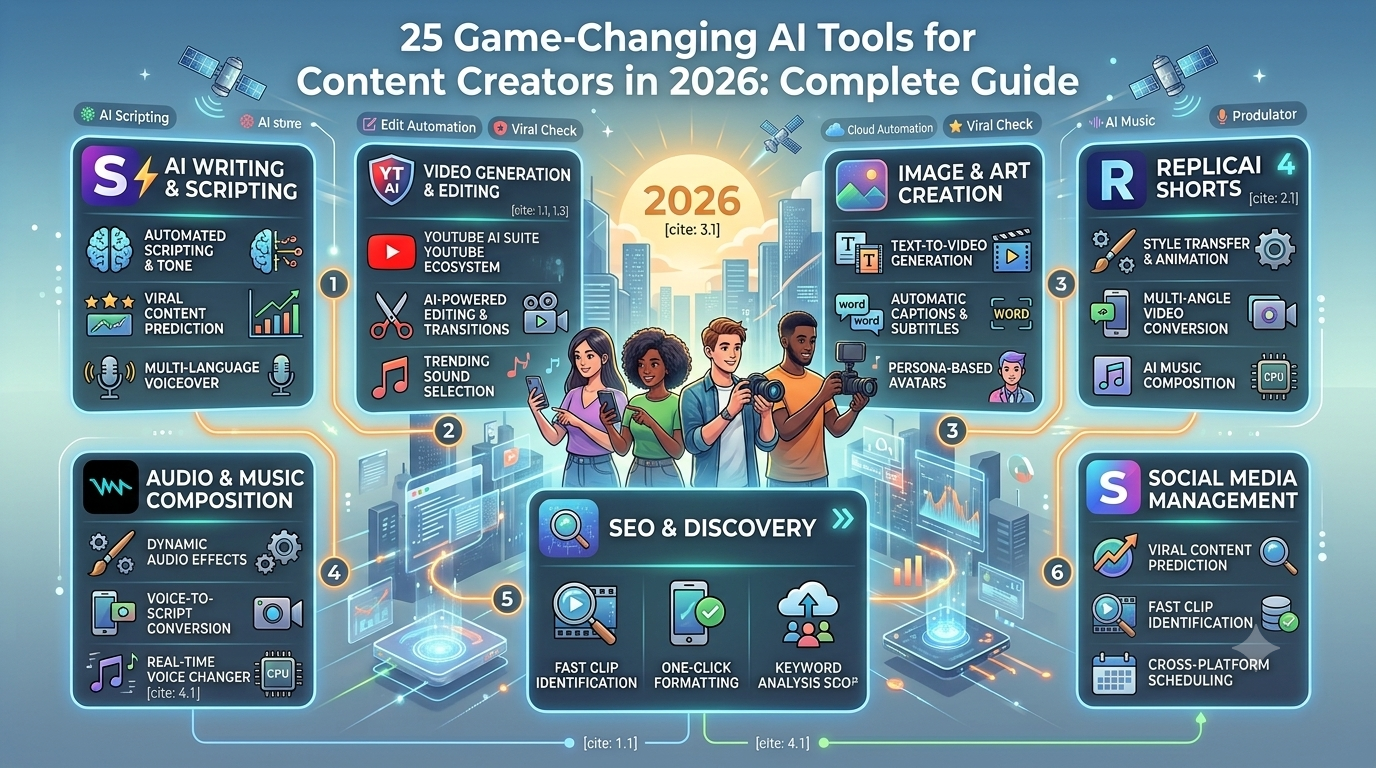
If you're still building content the old-fashioned way in 2026, you're not just working harder than your competitors — you're working in a completely different era. Content creation has never been more competitive — or more assisted. In 2026, artificial intelligence has moved from novelty to necessity, with 85% of marketers now using AI tools in their workflows, up from 61% just three years ago. That's not a trend — that's a transformation.
An estimated 312 million AI-assisted web pages are published monthly in 2026, up from 82 million in 2024. This flood of content has intensified competition for visibility in both traditional and AI search. That means if you're not using AI tools strategically, someone else with fewer ideas but smarter tools is outranking you right now.
The good news? For many creators, AI tools increase productivity 2–4x compared to traditional workflows. This guide cuts through the noise and delivers the 25 best AI tools for content creators in 2026 — organized by use case, audience type, and actionable ROI benchmarks — so you can build a workflow that actually moves the needle.

Key Takeaways
AI adoption is now mainstream — and mandatory: 85% of marketers now use AI for content creation in 2026, meaning any creator still working manually is competing at a structural disadvantage. Start with at least one AI writing tool this week.
Productivity gains are real and measurable: Workers leveraging AI tools report average productivity increases of 40%, with 77% of C-suite leaders confirming measurable productivity gains from AI implementation in the past year. If your AI tools aren't saving you 3+ hours per week, you're using the wrong ones.
Human editing remains the critical differentiator: AI-assisted content that is well-edited and factually grounded performs 12% better in AI search citations than purely human-written content, while unedited AI content performs 34% worse. Never publish raw AI output — always add your perspective and review.
Video and image AI are rapidly democratizing production: High-definition text-to-video generation costs dropped 40% between 2025 and 2026. If you're not producing video content yet, the cost barrier just evaporated.
Content creation tools deliver outsized ROI: Content creation tools deliver 420% ROI, making them one of the highest-returning AI investments for marketers. Budget at least $50–$150/month for your AI stack — it should return multiple times that value.
Quick-Start Prioritization Framework
A solo blogger may prefer ChatGPT or Claude for flexibility and long-form drafting, while a marketing team may benefit more from Jasper, Copy.ai, or Writer. A fiction author may find Sudowrite more useful than a business-focused platform, while an editor may rely heavily on Grammarly. Use this table to find your fastest path to ROI:
Tool CategoryBest ForEffort to Set UpTime to First ResultAI Writing (ChatGPT, Claude)Bloggers, solo creatorsLowMinutesBrand Marketing AI (Jasper)Marketing teams, agenciesMediumDaysSEO Optimization (Surfer SEO)SEO-focused bloggersMediumWeeksVideo AI (Runway, HeyGen)YouTubers, video creatorsMediumHoursVisual Design (Canva AI, Midjourney)Social media creatorsLowMinutesAudio/Podcast (Descript, ElevenLabs)Podcasters, video editorsLowHoursContent Repurposing (Opus Clip)Multi-platform creatorsLowMinutesResearch (Perplexity AI)All creator typesLowImmediate
Start here based on your situation:
Solo blogger or writer: Begin with ChatGPT or Claude (free tiers available) + Grammarly for editing. This combo handles 80% of your content workflow at minimal cost.
YouTube creator or video marketer: Lead with Descript for editing + Opus Clip for repurposing. You'll reclaim 5–10 hours per video immediately.
Marketing team or agency: Start with Jasper AI for brand-consistent output and Surfer SEO for ranking optimization. Pair them together for maximum content ROI.
Social media-first creator: Use Canva AI Magic Studio for visuals and Copy.ai for captions. Fast, affordable, and purpose-built for your workflow.
AI Writing & Long-Form Content Tools
These are the workhorses of any content creator's toolkit. The best AI writing tools in 2026 combine speed, accuracy, personalization, and strong editing features. ChatGPT, Claude, Gemini, Jasper, Copy.ai, Writer, Grammarly, Notion AI, Sudowrite, and Writesonic stand out for different creator needs.
1. ChatGPT (OpenAI)
Best for: Writers, bloggers, marketers, and anyone who needs a versatile all-purpose content partner.
ChatGPT remains one of the most versatile AI writing tools for content creators in 2026. It is widely used for brainstorming, outlining, drafting, rewriting, summarizing, scripting, and repurposing content across multiple platforms. Its strength lies in flexibility: a creator can use it to plan a blog post, draft a YouTube script, develop newsletter angles, create social captions, and refine a brand message in the same workspace.
Pricing: Free tier available; ChatGPT Plus at $20/month | Website: chatgpt.com
Pro Tip: Don't use ChatGPT as a one-shot content machine. Use it iteratively — get a rough outline, then refine section by section using role-based prompts like "Act as a senior [niche] writer targeting [audience]." In my experience, this approach yields content that needs 50% less editing.
2. Claude (Anthropic)
Best for: Long-form blog posts, essays, newsletters, and complex research-heavy writing.
Claude stands out for its ability to produce nuanced, natural-sounding long-form content. It excels at maintaining a consistent voice across extended articles, adapting tone to different audiences, and handling complex research-heavy writing tasks. Its strength lies in contextual understanding — it remembers the arc of a piece and keeps it coherent from introduction to conclusion.
Pricing: Free tier; Claude Pro at $20/month | Website: claude.ai
3. Jasper AI
Best for: Marketing teams, professional bloggers, agencies maintaining brand consistency at scale.
Jasper AI comes with over 50 templates, making it easy to create everything from product descriptions to long-form blog posts. You can set specific briefing requirements and adjust the tone to maintain a consistent brand voice across all your content. One of Jasper's standout AI features is Jasper IQ, which acts as a central hub for your brand's information. By feeding it your style guides and company facts, you can ensure all generated content is perfectly on-brand.
Jasper AI is an AI marketing platform that unifies brand voice and accelerates content velocity with agentic workflows for campaign production. It targets professional marketing teams and enterprises.
Pricing: From $39/month for individuals; team plans available | Website: jasper.ai
4. Copy.ai
Best for: Social media copy, ad headlines, email subject lines, and short-form content creation.
Copy.ai is known for short copy: ads, hooks, captions, and headlines that need to be punchy. It excels at generating multiple variations quickly, making A/B testing content a breeze. If your primary bottleneck is coming up with engaging hooks and captions at scale, Copy.ai removes that friction entirely.
Pricing: Free plan available; paid plans from $36/month | Website: copy.ai
5. Writesonic
Best for: Long-form SEO blog posts, product reviews, and structured marketing content.
Writesonic often focuses on long-form blog posts and structured marketing content, with templates that guide a creator from headline to conclusion. It includes a built-in AI article writer, brand voice features, and a Chatsonic conversational AI that can search the web for real-time information — making it a strong option for news-adjacent content.
Pricing: Free trial; plans from $16/month | Website: writesonic.com
AI SEO & Content Optimization Tools
Search engine optimization has evolved significantly with the advent of AI content creation tools. AI tools can analyze search trends and suggest the most relevant keywords for your content. This automation saves time and ensures your content is optimized for search engines. These platforms are non-negotiable if ranking is a core goal.
6. Surfer SEO
Best for: Content teams and bloggers who need data-driven SEO optimization with real-time scoring.
Unlike tools that analyze 20-30 basic metrics, Surfer SEO examines over 500 ranking factors, including content structure, keyword density, NLP terms, headings, images, internal links, and SERP patterns. The result is a highly specific, actionable content roadmap for any target keyword.
The biggest change in 2026 is Surfer's strategic pivot from traditional SEO to AI Search Optimization, with their new tagline: "Pricing & Plans for teams that want to win AI search — not guess it." This matters because 25% of Surfer's new customers now come from AI assistants like ChatGPT, Perplexity, and Gemini. Therefore, if you're not optimizing for AI search visibility in addition to Google, you're leaving a rapidly growing discovery channel unaddressed.
Pricing: Essential Plan at $99/month ($79/month annually), including 30 Content Editor articles, 5 AI articles, 100 page audits, unlimited keyword research, and 2 team members. | Website: surferseo.com
7. Frase.io
Best for: Research-intensive content creation and competitive SEO analysis.
Frase offers flexible pricing: Free trial, Basic at $45/month for 30 search queries, and Team at $115/month for 3 users with unlimited queries. Frase isn't just another AI writer — it's a content intelligence platform with insane research capabilities. I've found that Frase's "content brief" feature alone is worth the subscription for any serious SEO-focused blogger — it aggregates what top-ranking pages cover so you can out-answer competitors.
Pricing: Basic at $45/month; Team at $115/month | Website: frase.io
8. Perplexity AI
Best for: Research, fact-checking, and sourcing credible data for any content type.
Perplexity is a cutting-edge AI tool that transforms the way content creators perform web searches and research. It provides precise, context-aware answers by synthesizing information from multiple sources. Unlike traditional search engines, Perplexity presents summarized results alongside citations, enabling users to verify sources and dive deeper into topics.
Pricing: Free tier available; Perplexity Pro at $20/month | Website: perplexity.ai
Pro Tip: Use Perplexity AI as your pre-writing research tool before touching any generative writing platform. Spend 10 minutes gathering stats and data with Perplexity, then feed those findings into ChatGPT or Claude as context. The result is content that's grounded in real facts — not AI hallucinations.
AI Video Creation & Editing Tools
91% of businesses use video as a marketing tool in 2026, and 42% of marketers have adopted generative AI for video creation. This means the competitive bar for video quality is rising — and AI is the great equalizer.
9. Runway ML
Best for: YouTubers, video marketers, and anyone who needs cinematic-quality video without a full production team.
Runway is for creators who want to push video production further. It offers AI-powered tools for video generation, background removal, motion tracking, and visual effects. In 2026, it's become essential for YouTubers and video marketers who need cinematic quality without a full production team.
Pricing: Free tier available; Standard from $15/month | Website: runwayml.com
10. Descript
Best for: Podcasters, YouTubers, and video editors who want to streamline editing dramatically.
Descript fundamentally changed how we edit audio and video. You don't edit the timeline. You edit the text. It transcribes your media file, and then you simply delete words in the transcript, and the video cuts itself. For creators who hate the traditional timeline editing interface, this is transformative.
If your podcast guest says "um" 47 times, you click a single button. Descript removes every filler word, smooths the audio cuts, and saves you three hours of tedious timeline work. That's not a marketing claim — that's 3 hours per episode back in your calendar. If you produce weekly content, that's over 150 hours reclaimed per year.
Pricing: Free plan available; Creator plan from $24/month | Website: descript.com
11. Synthesia
Best for: Training videos, product explainers, and professional presentations without a camera setup.
Synthesia helps you generate AI avatar videos, while Runway ML assists in professional-grade video editing with minimal effort. Synthesia and Runway ML are top picks for YouTube creators in 2026. With Synthesia, you can produce a polished talking-head video simply by typing a script — no lighting, no camera shyness, no re-recording.
Pricing: Personal plan from $22/month | Website: synthesia.io
12. HeyGen
Best for: Product explainer videos, multilingual marketing, and AI avatar spokesperson content.
HeyGen specializes in AI avatar videos, a format that has grown dramatically for product explainers, training content, and international marketing. You can create a photorealistic spokesperson without a camera, studio, or on-screen talent. HeyGen also offers real-time voice translation, making it a powerful tool for creators targeting international audiences.
Pricing: Free trial available; Essential from $29/month | Website: heygen.com
13. Opus Clip
Best for: Multi-platform creators who need to repurpose long-form video into short-form social content.
Opus Clip solves one of the biggest challenges in modern content strategy: repurposing. It takes long-form video (YouTube episodes, webinars, interviews, podcasts) and automatically identifies the most engaging moments, clips them, adds captions, and formats them for social media. What once took hours of editing now takes minutes.
Opus Clip is an AI video repurposing platform that finds the most compelling moments in long videos and generates short-form clips optimized for each social platform. It serves creators, marketers, media teams, and agencies with automation and collaboration features, including AI clipping with Virality Score and multi-source imports.
Pricing: Free plan available; Pro from $19/month | Website: opus.pro
Pro Tip: Record one long-form video per week (30–60 minutes) and feed it into Opus Clip. You can generate 7–10 short-form clips per video — enough to post daily across TikTok, Instagram Reels, and YouTube Shorts without creating any additional content from scratch. This is where single creators beat entire social teams.
AI Visual Design & Image Generation Tools
In 2026, a comprehensive Reuters Digital Media Report revealed that AI-generated images now account for 79% of all visual content posted on major platforms including Instagram, TikTok, and Pinterest, with tools like Midjourney v7 and Adobe Firefly 3.0 collectively processing over 4.2 billion image generation requests per month. Therefore, if you're still sourcing stock photos for every piece of content, you're already behind the creative curve.
14. Canva AI (Magic Studio)
Best for: Social media creators, bloggers, and marketers who need professional visuals fast without design skills.
In 2026, Canva Magic Studio has taken visual creation to a new level. With AI-generated images, one-click background removals, and brand consistency tools, creators can design thumbnails, blog graphics, and social media visuals faster than ever. The Magic Write feature even generates captions and ad copy directly inside Canva.
Canva remains the most accessible design platform for non-designers, and its AI features have matured significantly. Magic Design generates entire layouts from a prompt, while AI image generation and background removal tools make quick work of social media graphics, thumbnails, and presentations. For content creators who need visuals fast but aren't designers, Canva AI is the default choice.
Pricing: Free plan available; Canva Pro from $15/month | Website: canva.com
15. Midjourney V7
Best for: Digital artists, bloggers needing distinctive featured images, and creators who want unique visual identity.
For creators who need striking, original images — not stock photo derivatives — Midjourney is the gold standard. Its ability to generate unique, high-aesthetic visuals from text prompts makes it invaluable for blog featured images, branded social content, and creative projects that demand a distinctive visual identity.
Pricing: Basic plan from $10/month | Website: midjourney.com
16. Adobe Firefly
Best for: Creators already in the Adobe ecosystem who need AI image capabilities with clear commercial licensing.
Adobe Firefly is Photoshop's AI engine, now deeply integrated into the Creative Suite. It's the preferred tool for creators who already work in the Adobe ecosystem and need AI capabilities with commercial licensing clarity. This is especially important for professional creators and agencies that need to guarantee their visuals are commercially safe to publish.
Pricing: Included with Adobe Creative Cloud plans (from $54.99/month) | Website: adobe.com/products/firefly
17. DALL-E 3 (OpenAI)
Best for: ChatGPT users who want seamless image generation integrated into their writing workflow.
DALL-E, developed by OpenAI, allows creators to generate images based on detailed prompts. Its integration directly inside ChatGPT means you can go from writing a blog post to generating a matching featured image without ever switching tabs — a seamless productivity boost for solo creators.
Pricing: Included with ChatGPT Plus ($20/month) | Website: openai.com/dall-e-3
AI Audio & Voice Tools
The podcasting market is exploding, and AI is making audio production dramatically more accessible. Video podcasts continue to gain preference among listeners, which means high-quality audio is no longer optional — it's a baseline expectation.
18. ElevenLabs
Best for: Creators needing realistic AI voiceovers, audio narration, or voice cloning for video content.
ElevenLabs offers some of the most realistic AI-generated voices available in 2026, with support for 30+ languages and the ability to clone your own voice from just a few minutes of audio. This is where creators building multilingual content channels or scaling narration without hiring voice actors will find immense value.
Pricing: Free tier available; Starter from $5/month | Website: elevenlabs.io
19. Otter.ai
Best for: Podcasters, interviewers, and meeting-heavy creators who need fast, accurate transcription.
Otter converts spoken audio into written text with AI-powered speaker identification, summary generation, and searchable transcripts. After years of testing transcription tools, I've found Otter is the fastest path from recorded conversation to publishable written content — whether that's a show notes document, a LinkedIn article, or a full blog post.
Pricing: Free plan available; Pro from $16.99/month | Website: otter.ai
Pro Tip: Record every podcast interview with Otter running simultaneously. By the time the episode is published, you already have a full transcript. Feed that transcript into ChatGPT or Claude and ask it to "turn this transcript into a 1,500-word blog post" — you've just tripled your content output from a single recording session.
AI Productivity, Planning & Workflow Tools
Native AI within your content management system saves an average of 2.5 hours weekly. Therefore, choosing tools that integrate into your existing workflow — rather than requiring you to switch contexts — is the highest-leverage productivity decision you can make.
20. Notion AI
Best for: Content creators who want AI writing assistance embedded directly in their planning and organization system.
Notion AI is best suited for creators who want writing assistance built directly into their planning and knowledge management system. Since many content creators already use Notion for calendars, databases, notes, briefs, scripts, and project management, its AI features can help connect planning with execution. Notion AI can summarize notes, generate content outlines, turn rough ideas into drafts, organize research, and create action items from meetings or brainstorming sessions.
Pricing: Notion AI add-on at $10/member/month | Website: notion.so/product/ai
21. Grammarly
Best for: All content creators who want to polish, proofread, and refine any AI-generated or human-written copy.
In 2026, Grammarly's AI features go beyond basic correction. It can suggest rewrites, adjust tone, improve flow, and help writers communicate more effectively. It is especially useful for bloggers, newsletter writers, students, professionals, and social media creators who want cleaner copy before publishing.
Grammarly offers a free plan with basic grammar and spelling checks. Its premium plan starts at $12 per month (billed annually) and includes advanced suggestions for style, clarity, and tone, as well as a plagiarism checker.
Pricing: Free plan available; Premium from $12/month | Website: grammarly.com
22. Zapier (AI Workflows)
Best for: Creators who want to automate the repetitive, behind-the-scenes steps of their content workflow.
Workflow automation tools like Zapier and Make deliver the highest ROI (2–5× typical), followed by meeting tools and governed content tools like Jasper and Canva AI. Think of Zapier as the glue between all your AI tools — automatically moving new blog posts to social queues, triggering newsletter sends, or pushing transcripts to Google Drive without lifting a finger.
Pricing: Free plan available; Professional from $19.99/month | Website: zapier.com
AI Social Media & Distribution Tools
In 2026, 82% of bloggers use AI tools to draft or edit their posts, and 70% of social media managers rely on AI for crafting engaging captions and posts. The volume expectations on social media have never been higher — these tools help you keep up without burning out.
23. Buffer AI Assistant
Best for: Social media managers and creators who need AI-powered caption writing and scheduling in one platform.
Buffer's built-in AI assistant generates platform-specific captions, suggests optimal posting times, and repurposes existing content for different social channels. The creator economy in 2026 is powered by artificial intelligence. From writing viral captions to generating videos, designing posts, and scheduling content across platforms, AI tools have become essential for creators who want to grow faster without burning out.
Pricing: Free plan available; Essentials from $6/month | Website: buffer.com
24. Gemini (Google)
Best for: Google Workspace users, researchers, and creators who need AI tightly integrated into docs, email, and presentations.
Gemini can assist with written content, image interpretation, presentations, and campaign planning. This makes it relevant not only for bloggers and copywriters but also for educators, consultants, and social media managers. Best for: Google Workspace users, research support, productivity-driven writing, and multimodal content planning.
Pricing: Free tier; Gemini Advanced at $19.99/month | Website: gemini.google.com
25. Rytr
Best for: Budget-conscious creators who need a capable, affordable writing assistant for short-to-medium form content.
Rytr is one of the most popular AI writing software platforms with over 6.5 million users. It focuses on straight-up text generation with a few twists, featuring 40+ templates or "Use Cases." For content marketers, these include templates for blogs, emails, product descriptions, ads, and web copy. At $9/month on the Saver plan, it's the most accessible paid option for creators just entering the AI workflow.
Pricing: Free plan available; Saver plan from $9/month | Website: rytr.me
How to Choose the Right AI Tool Stack for Your Needs
With 25 tools on this list, the instinct is to try them all. Resist that. Despite their power, AI tools should be used strategically. The biggest mistakes include publishing AI-generated content without editing, relying entirely on AI for originality, ignoring brand voice consistency, and using too many tools simultaneously. The most effective workflows combine AI assistance with human creativity.
The "Core 3" Framework
In my experience, the best content creators in 2026 don't run 15 AI subscriptions — they run 3 powerful, deeply integrated ones. Here's the recommended stack by creator type:
Solo Blogger: ChatGPT ($20/month) + Surfer SEO ($79/month) + Grammarly ($12/month) = $111/month. This stack writes, optimizes, and polishes everything you publish.
YouTuber: Descript ($24/month) + Opus Clip ($19/month) + Canva AI Pro ($15/month) = $58/month. This stack edits, repurposes, and brands your video content.
Social Media Creator: Canva Pro ($15/month) + Copy.ai ($36/month) + Buffer ($6/month) = $57/month. This stack designs, writes, and publishes across every platform.
Pro Tip: Before subscribing to any paid tool, look for a 7–14 day free trial and run one complete content project — from ideation to publish — using the trial period. If the tool doesn't save you at least 2 hours on that project, it's not the right fit for your workflow.
Content Quality vs. AI Output: The Golden Rule
Approximately 31% of publishers use AI for first-draft generation followed by heavy editorial review, 41% use AI exclusively for research, outlines, and data analysis without generating draft text, and 28% use a hybrid approach with AI generating sections that are then rewritten by editors.
The bottom line: the highest-performing creators are using AI as a research and drafting accelerator, not a replacement for human thought. Brands that stand out in 2026 are those adding original research, unique data, and human perspective to AI-assisted workflows.
Common AI Tool Mistakes Content Creators Make in 2026
What actually works is avoiding these pitfalls before they cost you months of wasted effort:
Mistake 1: Publishing raw AI output without editing. Unedited AI content performs 34% worse in AI search citations than human-edited content — and audiences can immediately detect generic, lifeless writing. Always add your voice, expertise, and original perspective before publishing.
Mistake 2: Ignoring AI search optimization. Only 54% of organisations are preparing to optimise content for AI-powered discovery tools, meaning nearly half of brands are missing a huge opportunity. Optimising for AI citation has become as important as traditional SEO in 2026. Tools like Surfer SEO now specifically address this gap.
Mistake 3: Chasing new tools instead of mastering existing ones. Choose your tools based on your content type, workflow, and goals. Start with one or two, build them into your process, and expand from there. The stack that works is the one you'll actually use consistently.
Mistake 4: Skipping human editing for brand voice. 73% of creators combine AI with human writing — the approach producing the strongest results. Only 5% rely mostly on AI without human oversight.
Pro Tip: Set a personal rule: every piece of AI-generated content must include at least one original insight, personal anecdote, or piece of proprietary data that only you could add. This is what separates forgettable AI content from genuinely valuable, rank-worthy content.
Frequently Asked Questions
What are the best AI tools for content creators just starting out in 2026?
The best entry-level combination is ChatGPT (free tier) for writing and ideation, Canva AI (free tier) for visuals, and Grammarly (free tier) for editing. Most AI tools offer free or affordable tiers. Many creators start with free plans from tools like ChatGPT, Canva, and Notion AI before upgrading as their needs grow. Start with free tiers, master one tool at a time, and upgrade only when a paid feature directly solves a workflow bottleneck.
How much should I budget for AI content tools per month in 2026?
The median publisher spends $12,400 per month on AI content tools, representing 8.7% of their editorial technology budget. However, individual creators and small teams can build a fully capable AI stack for $50–$150/month. Prioritize tools that handle your highest-volume or most time-consuming tasks first.
Will AI tools hurt my Google SEO rankings if I use them for blog posts?
Google's March 2025 core update reduced rankings for 61% of sites with over 80% AI-generated unedited content, but had minimal impact on sites using AI-assisted workflows with human editing. The key is using AI to draft and structure content, then applying meaningful human editing, original insights, and factual accuracy. AI-assisted + human-edited content actually performs better than fully human-written content in some AI search environments.
Which AI tool is best for YouTube content creators specifically?
Descript is a game-changer for creators working with audio and video content. This AI tool is perfect for podcasters, YouTubers, and content creators who want to produce polished content without a steep learning curve. Pair Descript with Opus Clip for repurposing and Canva AI for thumbnails, and you have a complete YouTube production and distribution workflow.
How do AI tools help with content repurposing?
AI tools don't replace creativity; they remove the friction that slows it down. They handle research, drafting, formatting, and distribution so that creators can focus on what matters most: strategy, originality, and genuine human connection. Specifically, tools like Opus Clip automate video repurposing, while ChatGPT can turn a single blog post into 10 social media posts, an email newsletter, and a YouTube script in under 15 minutes.
Are free AI writing tools good enough for professional content creation?
Many tools now run on advanced language models and offer strong free plans, so beginners do not need to pay just to experiment. Free tiers of ChatGPT, Canva, Grammarly, and Perplexity AI are genuinely capable for producing professional-quality content. The limitations typically involve usage caps, not output quality — upgrade to paid plans when you hit volume limits.
How do I avoid my AI-generated content sounding generic?
AI is still a helper, not a writer of record. Audiences can spot lifeless, generic content. The smartest creators use AI to speed up ideas and first drafts, then add stories, opinions, and real experience. Concretely, this means feeding AI tools with your own research, real examples, and specific data — not just asking for generic articles. Tools like Jasper AI and Writer allow you to upload brand voice guidelines to keep outputs distinctly yours.
The Bottom Line
AI tools have made it genuinely possible for a single creator to produce the volume and quality of content that once required an entire team. But the technology only amplifies what you bring to it. Strategy, audience empathy, and original thinking remain the differentiators. The best AI tools in 2026 are the ones that free you to spend more time on those things, not less.
Whether you're a solo blogger, a full-time YouTuber, or a marketing team of five, the 25 tools in this guide give you a complete, research-backed roadmap to building your AI content stack. Start with your biggest bottleneck. Master one tool. Then build from there.
For more guides on AI tools for content creators, developers, and digital entrepreneurs, visit createswowtech.com.
Sources
Best AI Tools for Content Creation in 2026 — Elementor Blog. Comprehensive guide covering key tools, trends, and statistics. https://elementor.com/blog/ai-tools-2026-guide/
Best AI Tools to Use for Content Creation in 2026 — ONLYOFFICE Blog. Tool-by-tool breakdown with use cases. https://www.onlyoffice.com/blog/2026/04/best-ai-tools-for-content-creation
AI Content Creation Statistics 2026 — Presenc AI. Data on AI content adoption, quality benchmarks, and SEO impact. https://presenc.ai/research/ai-content-creation-statistics
AI Content Creation Statistics 2026 — AutoFaceless Blog. 17 data-backed statistics on adoption and time savings. https://autofaceless.ai/blog/ai-content-creation-statistics-2026
AI Content Creation Statistics 2026: Adoption & Market Data — Affinco. 50+ statistics including market size and ROI data. https://affinco.com/ai-content-creation-statistics/
State of AI in Marketing (2026): 7 Trends Reshaping the Industry — Averi AI. Benchmarks on AI marketing adoption and workflow maturity. https://www.averi.ai/blog/the-state-of-ai-content-marketing-2026-benchmarks-report
Best AI Content Creation Tools in 2026 — MeetSona. Expert picks including Claude, Jasper, and Opus Clip. Expert picks for the best AI content creation tools in 2026 include ChatGPT Plus ($20/month) for writing and chat, Claude Pro ($20/month) for long-form content and coding, Perplexity Pro ($20/month) for research, and Jasper AI for marketing teams. ChatGPT